 Gocta Waterfall Tours
How to Get to Gocta Waterfall From Chachapoyas: Every Way Compared (2026)
Last reviewed August 2026
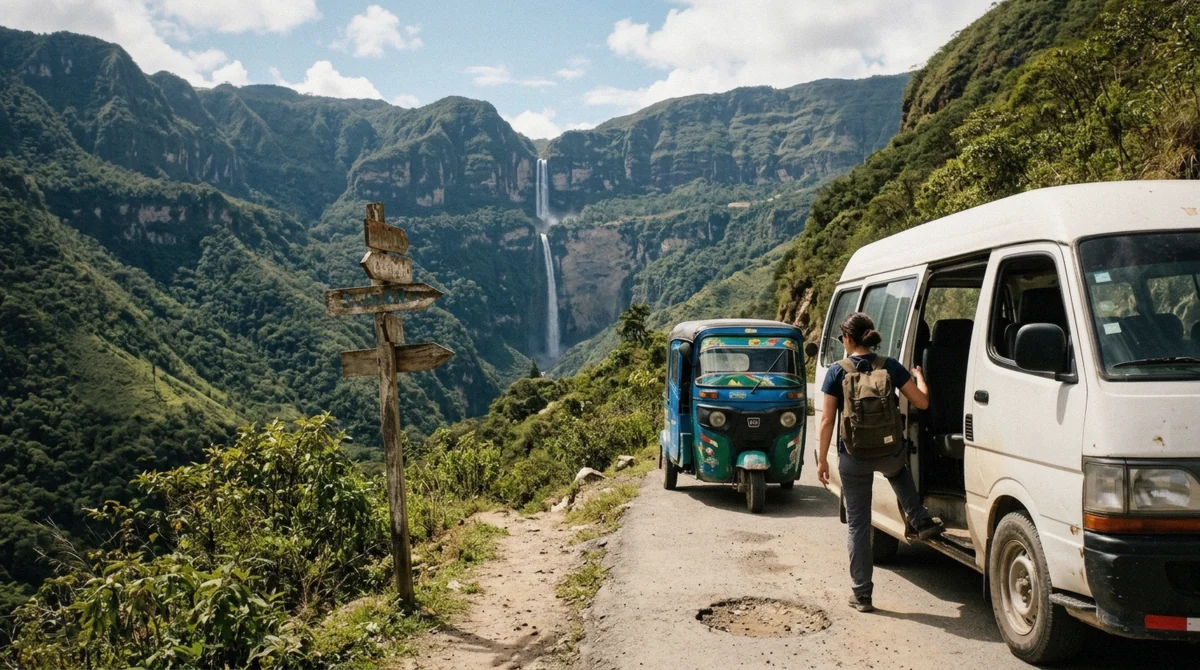
Working out how to get to Gocta waterfall from Chachapoyas takes a minute once you know the route: the fastest legs are by road to Cocachimba, one to two hours over 42 km, then about 5.5 km on foot to the base of the lower fall, since no road, shuttle or viewpoint reaches it by car. A shared colectivo toward Pedro Ruiz runs about S/ 5, with a tuk-tuk from the highway junction into the village around S/ 10 each way. Gocta waterfall tours from Chachapoyas run $44 to $50 and fold the whole transfer into one price, so the real decision is whether to arrange the legs yourself or let a guided day handle them. Fares and times below are read from operator listings and recent traveller reports, checked in August 2026.
Quick answer
The fastest way to Gocta waterfall from Chachapoyas is by road to Cocachimba, about 42 km and one to two hours depending on the vehicle, then roughly 5.5 km on foot to the base of the lower fall, since no road, shuttle or viewpoint reaches it by car. A shared colectivo toward Pedro Ruiz runs about S/ 5, with a tuk-tuk into the village around S/ 10 each way, or a guided day trip folds the whole trip into one $44 to $50 booking with the entrance ticket included.
Key takeaways
- The road ends at the village. From there it's about 5.5 km on foot to the base of the lower fall, roughly 2 to 3 hours each way
- A colectivo toward Pedro Ruiz costs about S/ 5, plus about S/ 10 for a tuk-tuk from the highway junction into Cocachimba
- Reaching the region at all usually means flying Lima to Jaén (about 1.5 hours) then 4 hours by road, since Chachapoyas' own airport has limited service
- Guided day trips run $44 to $50 and fold in the hotel pickup, the transfer and the entrance ticket
- The entrance ticket itself is paid in cash in the village, about S/ 10 for one fall or S/ 20 for the circuit. Full fee breakdown here
- Driving yourself is possible, but parking and the last stretch matter more than the route (see #driving below)
Which Way Fits Your Trip
If You have no car and want the cheapest route
Take the colectivo toward Pedro Ruiz (about S/ 5) and a tuk-tuk into Cocachimba (about S/ 10), then walk in
If You're short on time or on a tight schedule
Book a guided day trip. Pickup, transfer and the entrance ticket are handled for you
If You have a rental car
Drive yourself to Cocachimba and park near the village entrance. There's no road beyond it
If You're arriving from Lima with limited days
Fly to Jaén, not Chachapoyas directly. The CHH airport has limited service, and the direct Lima bus takes 22 to 24 hours
If You're coming from Tarapoto or Cajamarca
Overland is realistic. About 7 hours from Tarapoto, about 8.5 hours from Cajamarca
Where Gocta Actually Is
The short version
Gocta sits in Bongará province, in Peru's Amazonas region, on the eastern slope of the Andes where the mountains drop into cloud forest. The fall itself is a two-tier cataract reached only from the village of Cocachimba, 42 km from the regional capital, Chachapoyas. There's no road, cable car or viewpoint that reaches the base by vehicle.
Every visitor, on a guided tour or independently, covers the last stretch on foot or, for part of the way, on a hired horse.
Two villages, one road each
Two villages sit on opposite sides of the fall: Cocachimba, which every bookable tour uses, and San Pablo de Valera, reached by a separate side road and used mostly by independent hikers heading for the upper tier. Both are covered here for orientation; the full route comparison between them works through elevation, distance and which ticket each side needs.
Getting to Chachapoyas First
Flying in from Lima
For most travellers the practical route into the region starts with a flight from Lima to Jaén, about 1.5 hours in the air, followed by roughly 4 hours by road to Chachapoyas. Chachapoyas has its own small airport, CHH, but service is limited and seats book out fast in the high season, so the Jaén route is the one most itineraries actually use.
Overland options
A direct bus from Lima to Chachapoyas runs, but it's a long one: 22 to 24 hours on mostly mountain roads. Travellers already in northern Peru have shorter overland options: about 7 hours from Tarapoto, and about 8.5 hours from Cajamarca. Neither route is one to attempt on the same day Gocta is also on the plan.
| Route | Time | Notes |
|---|---|---|
| Lima → Jaén (flight) → Chachapoyas (road) | ≈1.5 h flight + ≈4 h road | The route most itineraries use; frequent flights between Lima and Jaén |
| Lima → Chachapoyas (direct bus) | 22 to 24 hours | Long overland option, mostly mountain roads |
| Tarapoto → Chachapoyas (overland) | About 7 hours | Realistic if already in northern Peru |
| Cajamarca → Chachapoyas (overland) | About 8.5 hours | Realistic if already in northern Peru |
| Lima → Chachapoyas (CHH airport) | Limited direct service | Book early; seats sell out in the high season |
Once you're in Chachapoyas
Chachapoyas sits at 2,235 m, a colonial-era town built around a central plaza, and it's the base every one of the region's guided day trips departs from, including the three Gocta waterfall tours compared here. Hotels cluster within a short walk of the plaza, which matters for pickup times on a guided day.
Chachapoyas to the Trailhead: Every Way Compared
The options at a glance
Once you're in Chachapoyas, four ways get you to the trailhead at Cocachimba: colectivo plus tuk-tuk, a private taxi, a rental car, or a guided day tour that folds the whole leg into one price. Figures below are read from operator listings and recent traveller reports, current as of August 2026; the live price on any booking page is the number that governs.
| Option | Time | Cost | Best for |
|---|---|---|---|
| Colectivo + tuk-tuk | 1 to 2 hours to Cocachimba | About S/ 5 + S/ 10 each way | Budget travellers comfortable navigating on their own |
| Private taxi | 1 to 1.5 hours | Higher than the colectivo, negotiated on the day | Small groups wanting a direct ride without transfers |
| Rental car | 1 to 2 hours, 42 km | Vehicle rental plus fuel | Travellers combining Gocta with other Amazonas sites |
| Tour with hotel pickup | 9:00 or 9:30 am departure, back by 5:30-6:00 pm | $44 to $50 per person, entrance ticket included | Anyone who wants the transfer, guide and ticket handled |
The tour row is the only option that folds the entrance ticket into the price. Full fee breakdown here; every DIY option means paying that separately, in cash, at the village office.
By Colectivo and Tuk-Tuk, Step by Step
The colectivo leg
Shared colectivos toward Pedro Ruiz leave from Chachapoyas and cost about S/ 5 per seat. They're shared minivans or cars that fill before leaving, so there's no fixed timetable to plan around, only a general flow of departures through the morning. Ask at your accommodation for the current departure point, since it shifts occasionally within town.
The tuk-tuk leg
From the highway junction near Pedro Ruiz, a tuk-tuk into Cocachimba (or on to San Pablo de Valera for the other route) costs about S/ 10 each way. Agree the fare before getting in; it's a short, well-known ride and drivers waiting at the junction know the going rate.
Getting back
The same combination works in reverse, but late-afternoon departures thin out. Travellers doing this independently generally plan to be back at the junction by mid-afternoon rather than risk a long wait for a colectivo after dark.
Where Everything Sits
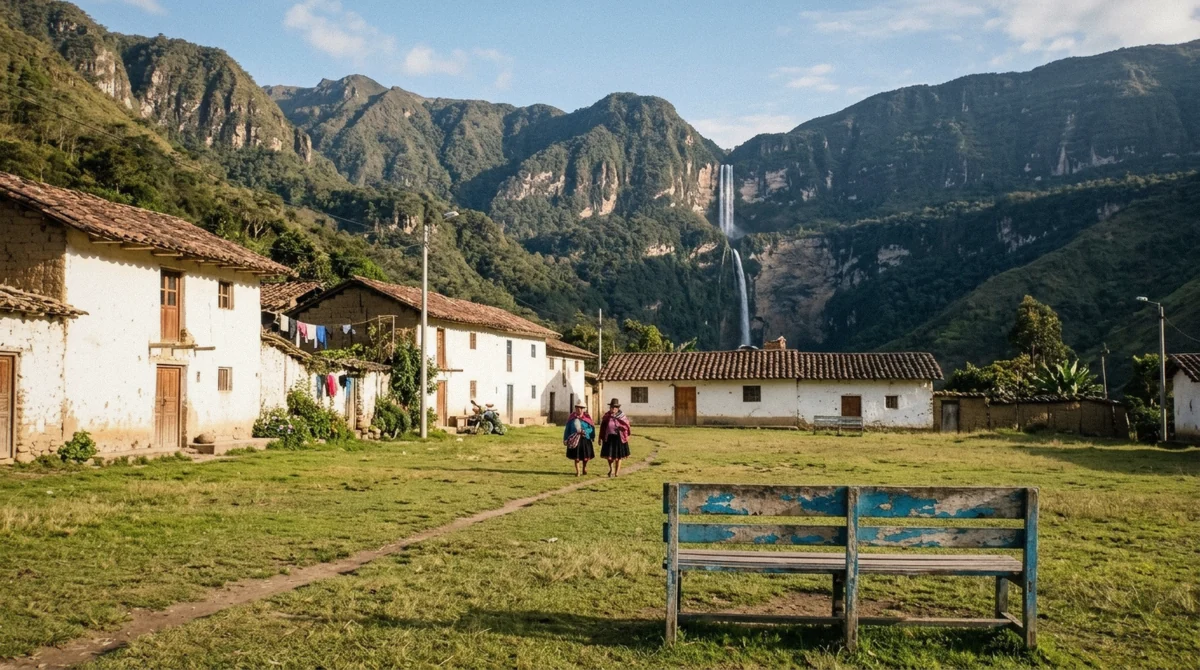
Chachapoyas is the hub every route starts from. Pedro Ruiz is the junction where the colectivo drops you and the tuk-tuk picks up. Cocachimba is the village every bookable tour uses; San Pablo de Valera sits on the opposite side and is covered in the full route comparison.
On a Guided Day Tour
What the transfer looks like
All three of the tours we compare here handle the Chachapoyas-to-Cocachimba leg in a similar way: pickup from your hotel or a central meeting point, an hour or so on the road, then the hike. The $47 full-day hike picks up at 9:30 am and returns between 5:30 and 6:00 pm. The $44 day trip leaves earlier, at 9:00 am, and the village departure itself is later, around 4:30 pm.
The $50 bilingual-guide trip picks up near the Plaza de Armas at 9:30 am and returns around 5:30 pm.
What's actually included
On all three, hotel pickup and the entrance ticket are included in the price; only the transfer method and the exact route timing differ. None of the three includes horse hire, which is arranged and paid for separately in the village if you'd rather ride part of the trail than walk it.
Driving Yourself
The route
The drive from Chachapoyas to Cocachimba covers the same 42 km as every other option, on a paved and then partly unpaved road, in one to two hours depending on conditions. There's no toll and no particularly technical stretch, though the final approach into the village narrows.
Parking
Cocachimba has informal parking near the village entrance; there's no multi-storey lot or reserved tourist parking, so arriving earlier in the day gives more room to choose a spot close to the trailhead. Nothing valuable should be left visible in the car, the same standing advice as anywhere a vehicle sits unattended for several hours.
Seasonal Changes on the Road and Trail
December to March
The unpaved stretch into Cocachimba, and the clay trail beyond it, both react to the wet season. The road itself stays passable for colectivos, taxis and tour vehicles, but the surface softens and a heavier downpour can slow the drive by adding extra minutes to the one-to-two-hour range quoted above. The trail turns genuinely slippery in this window; a waterproof jacket is on more than one operator's own packing list for exactly that reason.
May to September
Footing on both the road and the trail is at its most reliable in these drier months. Colectivo departures don't change on a fixed schedule either way, since they run whenever a vehicle fills rather than to a timetable, but drivers report fewer delays from washouts or standing water on the unpaved stretch near Cocachimba.
Accessibility, Luggage and Travelling With Kids
Luggage
Neither the Chachapoyas colectivo stand nor the village of Cocachimba has a formal luggage locker. Travellers doing Gocta as a day trip between hotels typically leave bags at their Chachapoyas accommodation rather than carrying them on the colectivo, tuk-tuk or tour vehicle; ask at check-in or check-out, since most guesthouses hold bags informally for guests moving on the same day.
Strollers and mobility
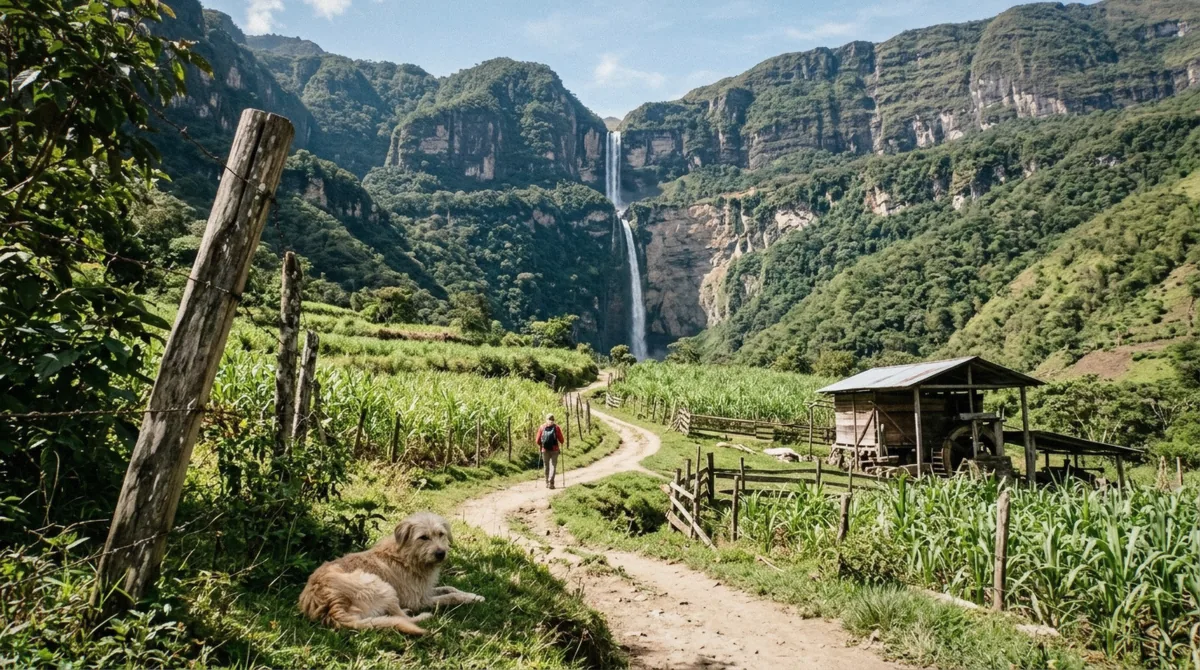
The last-mile walk from Cocachimba into the fixed trail is not stroller-viable once the path narrows and climbs, and none of the three tours state wheelchair access. A tuk-tuk or taxi handles the road portion fine for anyone with limited mobility; it's the roughly 5.5 km trail itself, not the transfer, that sets the real limit.
Which Village the Road Ends At
No shortcuts past Cocachimba
Whichever way you arrive, colectivo, taxi, rental car or tour bus, the road stops at Cocachimba. From there it's on foot (or on a hired horse for part of the distance) for about 5.5 km to the base of the lower fall. There's no shuttle, no cable car and no viewpoint reachable by vehicle beyond the village.
The other road
San Pablo de Valera has its own access road and its own parking, entirely separate from Cocachimba's. It leads to the upper-tier route rather than the lower fall most tours visit. The full comparison between the two covers distance, elevation and which ticket each route requires.
How Long the Whole Day Takes
Door to door
Counting from a Chachapoyas hotel and back, a guided day runs 7 to 9 hours depending on which trip you book, matching the road time, the hike and the time at the fall. Doing it independently by colectivo and tuk-tuk takes roughly the same total, since the road and trail times don't change, but with more waiting built in around transfers that aren't scheduled to a fixed clock.
The one variable that matters most
The 5.5 km trail from Cocachimba, at 2 to 3 hours each way, is the part of the day that decides everything else. It's covered in full, with elevation and difficulty, in the Gocta hike guide; this page only covers how to get to the trail, not what happens on it.
Getting to Gocta: Common Questions
How do I get to Gocta falls?
Get to Chachapoyas first, then cover the 42 km to the trailhead village of Cocachimba by road, then walk. The three ways to cover that 42 km are a colectivo towards Pedro Ruiz plus a tuk-tuk, a guided day trip that collects you at your hotel, or a private taxi. From the village the last stretch is on foot or on horseback, because no road reaches the waterfall.
Is there public transport to Cocachimba?
Not a direct bus. Public transport gets you most of the way: a shared colectivo runs from Chachapoyas towards Pedro Ruiz for about S/ 5, and from the highway junction a tuk-tuk covers the last climb into Cocachimba or San Pablo for about S/ 10. There is no scheduled service into the village itself, so the tuk-tuk or a lift is the final link.
What's the fastest way from Lima to Chachapoyas?
Fly Lima to Jaén, about 1.5 hours, then roughly 4 hours by road to Chachapoyas. The direct Lima to Chachapoyas bus exists but takes 22 to 24 hours, and Chachapoyas' own CHH airport has limited service.
Is there a direct bus from Chachapoyas to Cocachimba?
No scheduled bus runs that specific route. The colectivo-and-tuk-tuk combination toward Pedro Ruiz is the equivalent, or a guided day trip handles the transfer for you.
How much does a taxi from Chachapoyas to Gocta cost?
More than the colectivo-and-tuk-tuk combination, and negotiated on the day rather than metered. For a fixed number, a guided day trip at $44 to $50 folds the whole transfer into one price.
Where do the guided tours depart from?
From your hotel in Chachapoyas, or in the case of the bilingual-guide trip, from a pickup point near the Plaza de Armas. All three tours we compare include hotel pickup.
Is there parking at Cocachimba?
Informal parking near the village entrance, with no multi-storey lot or reserved tourist spaces. Arrive earlier in the day for the best choice of spot.
Can I reach Gocta without a car?
Yes. The colectivo toward Pedro Ruiz (about S/ 5) plus a tuk-tuk into Cocachimba (about S/ 10) covers it, or a guided day trip removes the need to arrange either leg yourself.
Is the road to Cocachimba paved the whole way?
Part paved, part unpaved for the final stretch into the village. It's passable year-round for colectivos, taxis, rental cars and tour vehicles, though the unpaved section softens in the December to March wet season.
Whichever leg you're weighing, the colectivo-and-tuk-tuk combination is the cheapest way in, a rental car suits anyone stacking other Amazonas stops onto the same day, and a guided day trip removes every transfer decision at once for a fixed $44 to $50. None of the three routes gets you past Cocachimba by anything other than your own legs or a hired horse, and that's the one constant the whole day is built around.